Discourse on how and why we play.

Wednesday, January 13, 2010

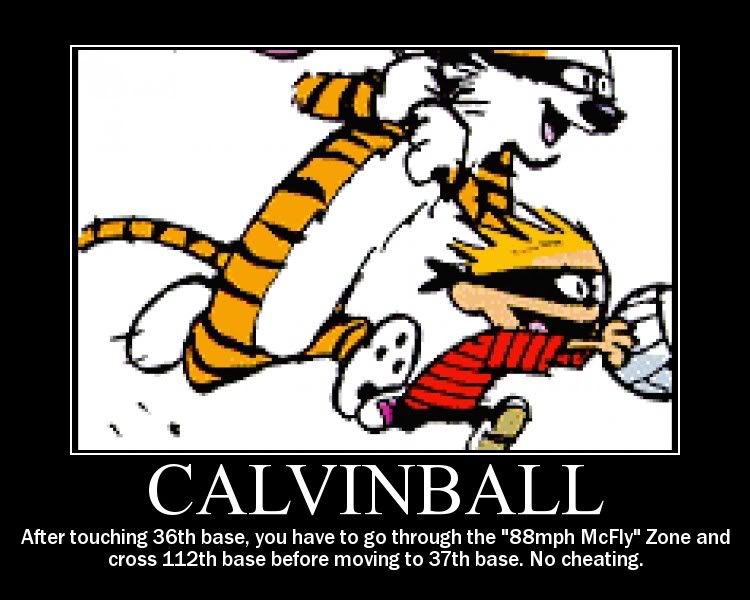
Calvinball!


Image courtesy User FlameDarkfire on Photobucket

I have recently been shocked by the incredibly high percentage of the population who looks at my like a mad man upon the mention of Calvinball. Apparently some poor under privileged youngsters out there were raised without even the merest mention of the sport. So for those of you out there who are lacking in Calvinball experience come and get your knowledge.


Beginning on
November 18, 1985 and running until December 31, 1995 Bill Watterson published his phenomenally successful comic Calvin and Hobbes in syndication across the world. The star characters were an imaginative 6 year old boy named Calvin and his pet "stuffed" tiger Hobbes. It is no stretch to say that even discounting Calvinball that the comic strip has inspired more people to play than maybe any other piece of mas media. The comics unabashedly promotes the importance of childhood activities and emphasizes that children must and will be free to be children,but all of this is worth another post all together at a later date.

Calvinball is a game unlike any other namely because it contains only one immutable rule,

"You cannot use the same rule twice"

Other than this anything goes. What makes Calvinball unique is that it is an innately physical game that places equal importance on creativity as on physical prowess and requires an inherent good sportsmanship that is lacking in many rule based games. Since rules can be made up by any player at any time, even contradicting preexisting rules, the players must learn to take creative loss in stride. This feature makes the game excellent for both children and well adjusted adults. Children can learn creativity and constructive argument skills as well as fair play in an environment that also keeps them physically active it also fosters the cliched "outside the box" thinking. As or adults it allows an excellent release from a society that is already governed by thousands of unquestionable rules.

In closing I'd like to leave you with The Calvinball theme song

Other kids' games are all such a bore!
They've gotta have rules and they gotta keep score!
Calvinball is better by far!
It's never the same! It's always bizarre!
You don't need a team or a referee!
You know that it's great, 'cause it's named after me!


Monday, January 11, 2010

What is Play? Enhancement


From the Wikimedia Commons Image Pool : Taken from http://www.flickr.com/photos/sookie/17464614/ Licensed under CC 2.0

In the first of what will likely be many thoughts on this topic from a the standpoint of pure unprofessional conjecture I would like to submit the idea that, contrary to what some may believe, we are not playing unless in some way we are improving. Since we as intelligent animals need certain skills to survive we have developed ways to impart the knowledge of these skills onto otherwise ignorant youngsters. Being that we are pretty hedonistic beings in our youth and unlikely to just sit and listen to whatever our elders have to say it seems that we've developed another way to learn, which is of course play. Play inherently improves us in some way all the time. As children we develop the skills required to survive through play, often times initiated by an older family member or mentor. We are hardwired to be learning skills quickly and enjoying learning these skills through play. This obviously begs the question why play as adults? Simply put, we don't stop learning and we enjoy using the skills we learned as children and developing new ones. We can see the issues of a loss of play in the common complaint "I'm just not challenged at work" when we stop growing and pushing the use of our skills work, which can be enjoyable and even considered play, becomes drudgery.

Lets look for example at something that would almost immediately be considered mind numbing monotony at any time. Sitting for hours in front of a computer monitor entering data, testing and retesting results, this continual work would usually be something to be dreaded, not anticipated eagerly. However for thousands of North Americans such as a myriad of independent game and software developers this is a hobby, this is play. It is play because they enjoy it and I would venture an educated guess that it is most enjoyable from the challenge that comes from creating it and the exhilarating pride that comes from its completion. This same logic can be applied to dozens of common hobbies, woodworking, gardening, even general exercise is enjoyed because it stimulates and improves us. It is a holdover from our enjoyment of improvement as children which we develop through play.

Thursday, January 7, 2010

Pure Play


Boys playing (Petrov-Vodkin) -Wikimedia Commons Picture Archives

I spoke yesterday with a man I respect immensely named Bob Appleton, he's a professor at Ryerson and a graphic designer of note but more importantly I view him as sort of a mentoring figure, which is odd since I have had him as my professor twice and neither class focused on learning but more doing. I digress what I find wonderful about Bob is that I can't stop talking to him once I start and when I'm speaking to him my thoughts seems to work themselves out as they fly from my mouth.

So yesterday after a long hiatus we spoke, notably about the importance of play and how it pertains to both art and society. During this conversation I came to reflect upon my previous statements and some notes and conversations about the idea of "perfect play"or "pure play", a sort of childish innocent play that was free of the seemingly guilty facets of adult play. So I suppose this post is some kind of retraction, or more of a re imagining for the sake of understanding my field better, I'm changing my notions of play or at least expanding on them. While it was fun to look at play as though it was some kind of universal mathematical constant, as was necessary for the project, I can't continue to look at it as a Psychologist or a Mathematician becasue I am neither of these, which also for my means giving up the search for "Pure Play" for the sake of actually understanding play better. I liken this to a musician who had the erroneous idea that some how he could make a song that every single person on the planet would enjoy, its a pleasant Lennonesque notion but I've come to the realization that I was dismissing the real play in favor of finding this single and ultimately elusive type. So I'm fondly waving goodbye to my Unified Play Theory, it will remain here on the site as documentation but in the name of knowing more about play I think I'll be putting it out to pasture.

Wednesday, January 6, 2010

Old News

This is likely old news for anyone with anyone with any interest in the field but it seems like a solid way to ease back into updating this joint regularly. First off let me say that this man Doctor Stuart Brown is everything I have come to admire about the modern thoughts on a society at play, not only is he a psychiatrist but he's an avid zoologist as well. His work on the brain functions of murderers brought him to the field of play and his work is part of a growing mountain of evidence that the removal of play in society may be a bigger erosive force in our society than we might otherwise have thought.

Linked below is his 26 minute TED talk in which he covers both animal and human play as well as his own findings in researching play for his play advocacy foundation the National Institute for Play. Of particular note in this video are his excellent ideas on getting the most out of employees in the creative economy. His students at the D school (at Stanford) study the impacts of play within the work place and I will concede its a place I would really like to attend. In summary watch the video linked below and be inspired by someone who has the foresight and credibility to see that its imperative to reintegrate play into a society beleaguered by depression, anxiety and other preventable issues.


Stuart Brown @ TED

National Institute for Play

Stuart Brown TED profile

Tuesday, January 5, 2010

Reboot

When this little blog began it was used exclusively academically to report on and to promote my 4th year New Media final project named Playspace. What started out as an art project that I was doing because I needed a university degree has been firmly planted in my mind for over a year and now seems to be the thing I feel most passionately about and that links all of my other thoughts and interests together. What has happened is that I have discovered that Play is my calling. Some people are passionate about music others about business but it seems like for Craig Herbert my life's work is going to be Play.

So on that note I would like to announce (mostly to myself) that Playspace the blog is officially reopened.

However since the project of the same name is over and done with the blog will be switching directions, or rebooting as the current vernacular trends seem to indicate. So we will from now on be focusing on the decidedly abstract notion of Play. To clarify this decision, because Play is a very broad and well represented field on the Internet, here at Playspace the focus will not be on video games, board games, sports or Internet and new media social media trends (although they will likely be discussed) but on how and why we as human beings incorporate play into our lives. It will be heavy on personal theory and might not jive with the way you experience the world but I do hope you will come away happy. There will be links to others discussing play around the Internet as well as those engaging in it, there will be personal experiences, and there will be critical analysis.

Thank you for reading and I hope you come back.
-Craig

Saturday, June 6, 2009

Finalization

Well Its all over and done with and it seems time to complete this blog and finally with the video from the gallery ready I will submit the documentation of Playspace to the history books enjoy these documentation shots and check of the video of the whole show courtesy of Adam Video">


Thanks to everyone who participated and keep Playing

Wednesday, February 4, 2009

Beta 1: Handout update

Below is the handout I will be distributing for the Thursday Feb 5th beta presentation of Playspace.


Playspace Update.


Finalized aesthetic.
A palette of red to yellow the colors that, according to my polls and research, are most likely to evoke the type of play we are searching for (creative and exciting)
Additionally after testing the iconography and taking the results of the polls into account I've have commissioned a series of icon based graphic pieces, also in the preferred colors,Of which the first 2 can be seen here, more will come after the beta and after further poll analysis.

Familiarity vs Instruction
While struggling to understand why it was difficult for participants to play under the circumstances I had laid out for them and after reading the polls and personal opinions,I began to toy with concepts of instructions. This goes against the entire goal of the project and so I have decided to go with familiarity in lieu of rules. As opposed to being told explicitly what to do, the audience is now confronted with a series of objects and settings that they are familiar with and are thus more predisposed to understand how to interact with them. This familiarity makes the project more user friendly without compromising the integrity with instructions.

Finalised Equation
CF = CM + SP +PE + DI

Where CF= Total Creative Force
CM = Cultural Merit (where the audience values what they are doing)
SP= Space Positivity (lack of judgement etc...)
PE = Psychological Effect(psychological stimulants)
DI = Direction (When faced with an over whelming amount of options people don't react well so they must be directed)

With the addition of DI my goal of 4 play conditions is fulfilled and I feel like I can get on with finishing the final project out of the research stage. Direction is the missing link the takes the work from a theoretical frame work to a viable experience.

Monday, January 26, 2009

Case Study 1 Little Big Planet

When doing the research for Playspace I was largely trying to stay away from video games as mediums of play. For while they are excellent distractions and in my personal opinion an emerging medium for art they are of insular and competitive experiences. Even games such as World of Warcraft while they consist of complex social interactions between thousands of people and are inherently a mulitplay experience they are very competition oriented and almost always violent, things that I was trying to shy away from in my pursuit of play. However since the beginning of this project one game has come out that has bucked the trend and has I hesitate to say almost beaten me to the punch in terms of collaborative/generative play. and that game is Little Big Planet


Having finally gotten a chance to play the game in its entirety through the generosity of my friend (I barely own a computer let alone a Playstation 3.) If the game were not so delightful I would almost feel dejected for its execution of an idea so close to the one I am working on, and it executes it very well. First for those of you who haven't had the pleasure of playing the game it is a wonderful blend of simplicity and overwhelming complexity. You exist as you avatar, the adorable and infinitely customizable Sackboy (seen above) whose actions are limited to grabbing objects, running an jumping in a game that is as simple as any video game has ever been this simplicity makes the game accessible to essentially everyone. Where the game really shines though is in its level editor, which come packaged with the software. It is a toy box with hundreds of textures, objects mechanical components and sounds which can come together in any million of different ways. Rather than attempt to explain the incredibly complex method of some of its capabilities I would direct your attention to a series of Youtube videos containing the vast array of user created content ranging from the relatively simple to the incredibly complex.


Sweet Child of Mine
Calculation Computer
Tetris
Combustion Engine


As you can see in these examples there is no shortage of creativity out there for these people and the tools are all there to create. I attempted this in my toys experiment, giving people a lot of tools to work with and there was success people seemed apprehensive alot of the time. Clearly this is not the case with Little Big Planet as when I looked yesterday there were thousands of levels on the sharing service. So I wonder what is the reason that these people are so keen on creating content? It seems that it is almost of a boastful nature, still very competitive, there is a feeling of "look what I have done , its the best" and so it seems that competition has pervaded here as well. However on a 2nd glance aside from popularity there is no reward for the creation of this content and to create something as complex as the computer, seen in the video, would undoubtedly take hours at least along with the relatively steep learning curve. I need to look into why people do this more, I think it could be of real use to Playspace

Sunday, January 25, 2009

Study 2 Motivation and Rules

On Friday I had the opportunity to opportunity to observe a K'nex build off sponsored by the engineering student society. The established goal for Playspace here was to watch and determine if I should alter the level of competition and the level of instruction in the space. Initially I did not intend to create any level of competition nor intruction for Playspace, it was to be extremly freeform, zero instruction of any sort. However between 1st hand data collection and the online polls I have set up along with the previous experiments the emerging trend seems to be that the average person regardless of their creativity or playfullness cannot reach their full potential without at least some direction. The K'nex contest was proof positive that a bare framework of rules can actually lead to more creativity than an open form activity. It may have something to do with having an anchoring point to work from (another thing I learned in Kludge), the human mind prefers to establish a point of reference and then move from that point on to other solutions, a phenomenon known as "anchoring". Either way it seems that I will have to give some manner of direction to the participants or else they may simply loose interest. However now the trouble falls on the fact that I must add some semblance of structure to the piece without focusing the creative energy too narrowly onto a specific area. As it stands currently the goal will be to decide between two ideas for a direction method, implied rules and setting a precident.

Implied Rules
The challenge of implied rules is finding a way to lead the participants towards directing themselves. Ideally this approach will make the user feel like there are no rules but still prevent him or her from from being too lost as to how to interact with the piece. The implimentation of this piece is still in the creation phase

Setting a Precident
When specific rules sets are not an option setting a precident seems to be the way to go, giving the audience a suggestion as to things that could be done with the space not only allows them to recreate what they see in the examples but also leads to the very rewarding experience of game breaking and the feeling of accomplishment that ensues. Whether there will be an series of pictures or a video or other examples of work in the piece remains to be seen.

Monday, January 19, 2009

Study 1 Kludge and the Psychology of Play

During the analysis of footage on the experiments on toys and playing with light it became more and more evident that while it is important to present the audience with an activity it is almost equally important to appeal to the less definable aspects of play namely the psychology of play. Over the break I read a few articles and periodicals about the psychology of play some of which were more helpful than others but to my surprise a book I was reading for pleasure Kludge was what was the most impactful of the readings. The book is about the construction of the human mind. Written by Gary Marcus the director of the NYU Infant language learning center the book focus' on the shortcomings of the human mind and more importantly to me why the brain falls for certain tricks.


Gary Marcus author of Kludge


Early in the year I spoke with Mark about the best way to get people to interact with an art piece and his advice was to essentially trick them into letting their guard down and having a meaningful interaction with the piece. In Kludge a large portion of the book is dedicated to the tricks and exploits that we are susceptible to because of the construction of our mind, tricks that advertisers, lawyers and other influential figures know of and use on a regular basis. So in the spirit of repurposing everyday occurrences as is so prevalent in New Media I will be conducting further experiments on the getting the human mind into a play susceptible mindset. Examples of this include the Halo Effect which is a part of the human minds reliance on constant input, color theory and the 'mere familiarity' effect. The Halo Effect is a cognitive hiccup that allows the human mind to be cross contaminated with thoughts from one part seeping into another. For example people without a strong opinion on extreme sports are asked to read and memorize 2 different sets of words. One group is shown words such as caution, danger, injury recklessness and a variety of dummy words to keep the effect from being obvious, while the other group is given words like stimulating, excitement, adrenaline etc. The people who were fed the cautionary words focus on the dangers inherent with extreme sports while the 2nd group focus on the exciting aspects. Color theory provides us with relations the the average human being has with colors and their relations to the world. Finally the mere familiarity effect states that when we are unsure of a solution a familiar solution is generally chosen ever if the familiarity is unrelated to the question. Through further readings and tests I hope to be able to help make playspace the playful space it needs to be. Finally the forays in the intangible elements of play have allowed me to add a 3rd variable to my play algorithm.

CF = CM + SP +PE

Where CF= Total Creative Force CM = Cultural Merit (where the audience values what they are doing) SP= Space Positivity (lack of judgement etc...) and now PE = Psychological Effect(the small psychological stimulants associated and talked about above)

Friday, January 9, 2009

Survey 2: Associations of Play

Please take this second poll as well it would be an excellent use of your time also it would help me a lot.

The Poll

Thursday, January 8, 2009

Survey 1: Rules and Authority

If you haven't already please take some time to fill out the first in a series of surveys on the topic of play for me. It will greatly aid the final product. Also feel free to be that guy and send it along to all your freinds with the threat or curses or the promise of true love attached to their email.

The Poll

Monday, November 17, 2008

Preview 1 Toys

11-21-8 Oakham House Conference Center Room 202

Friday November 21 is the date assigned for the inaugural free form experiment for Playspace. This experiment is formulated to include a number of people who have a limited amount if any previous contact to best emulate a non familiar gallery space where interaction will not be limited to acquaintances. The goal of this iteration is three fold, 1st to examine the physicality of play, IE: What people like to play with physically. 2nd To find out how strangers or relative strangers will interact when presented with the opportuity to play. 3rd to set out to prove the hypothesis that play may be successful when a creative record is established IE: When the audience is allowed to keep record of thier play.

The hypothesis here is one that explores the SP (Space Positivity) variable in the work. Until this point the experiments have all taken place with a relitivly close group of people who have not needed to over come the FI (Fearful Inertia) variable. In addition to the desire to observe people playing it will be a test of my abilitiy to create SP in a group of people with little or no previous contact which will be essential in the final gallery.

Also the name of the experiment may be a tad misleading as the objects placed in the room will not be toys of the conventional defiition. Rather they will simply be objects with or without a previous use that will allow for the users to project meaning onto the objects and have fun at the same time.

Note: This experiment will be filmed
Note: This will also explore a smaller hypothesis that was actually brought up by Stve Daniels in 3rd year in relation to brain storming. Notably the intrduction of sugar into the mix, Steve suggested always having cookies while brainstorming.

Tuesday, November 11, 2008

Experiment 4 Collective Canvas

11-09-08 Residence of Katie Goulay


After the trouble with previous events being to structured on the advice of a friend Playspace's 4th experiment was greatly simplified all that was requested was presence and some art supplies. Prior to the guests arriving there was a simple blue gradient painted on the canvas, this was done with the hopes of some cohesive direction for the piece. The blue gradient was ideal because it connoted either a sea scape or a sky scape both allowing for many possible directions for the smaller paintings to take. What is important to note about this exercise is very unstructured and is much closer in nature to how I imagine the final iteration of Playspace will function .


Initially I feared that the lack of direction would lead to a fear to participate and at the begining a few cries of " I don't know what to paint" could be heard although they were in the minority. After a few reassuring responces the painting was off to a roaoring start further proof that in order to truely gain project momentum you must first break the creative inertial wall. In mathematical terms,

CF > FI = AM (Desired Outcome) CF < fi =" CS (Undesirable Outcome Project Failure)
CF =
Creative Force FI = Fearful Inertia AM = Artistic Momentum CS = Creative Stagnation

Truly the greatest challenge of Playspace is going to be finding a way to easily and reliably break the inertial wall of gallery goers and get them to engage in meaningful play by building Artistic Momentum. However common denominators I have observed so far indicate that there are certain ways to attain a desirable Artistic Momentum, a Positive Space is nessisary as well as a feeling of worthy input which we will call Cultural Merit.

CF= CM + SP + ?? + ??
( Incomplete equation for building the Creative Force of Playspace)
CM =
Cultural Merit SP= Space Positivity

In reality all that needs to be done is to complete the varialbes in the Creative Force eqaution to create the highest level of stable Creative Force. That is one of the keys to making Playspace a success.
The canvas near completion


Experiment 3 Hide and Seek

11-08-08 Ryerson Quad Gould st

Prior to learning the lessons from the previous experiment about play structure being rigid I had planned an examination of the favored childhood pass time hide and seek. Ten players met on Saturday night for 1.5 hours of Manhunt, a variation on hide and seek where once found the players help the seeker find the remaining players. Rules were set as 15 minutes per game or the seeker having found everyone else. I realized 35 minutes in while hiding in a ball closet that upon sober reflection there was not a great deal I was learning from the experiment. It did not illustrate the interaction of people very well as it is generally solitary and quiet (much like a pre Playspace gallery) and it while it forces people into an interesting situation it is not the situation that I would like them to be in. One interesting piece of knowledge that did come from the activity was observing how people interact with their surroundings before and after they are given a reason to do so. For example while waiting for all the participants to show up nary a cursory glance was wasted on observing the contents of the quad, only after the game had begun did people seem to clue in to what was directly around them and then to interact with it. Overall while the project was enjoyable and engaged people easily with its familiarity I need to eliciting more stimulus response reactions from my subjects. When playing hide and seek the subjects already know how to react nothing is surprising, I need a way to keep them off guard in an unfamiliar setting where play will flow more naturally and not from nostalgia and competition.

Nostalgia is useful for engagement but must be strictly controlled for the sake of innovative play.

Attention can be directed through the use of stimulus IE: You must hide= observe surroundings

Monday, November 3, 2008

Experiment 2 Playing with Leaves

11-02-08 Allen Gardens, Carlton St


Remember when you were a kid and your parents would rake up the leaves in the front yard and keep them in piles before they bagged them up as yard waste? That was the impetus of this experiment, to recreate and analyze just what it is about a bunch of dead biomass that compels children and some adults to hurl themselves into it? To accomplish my goal I drafted some acquaintances and got them to aid in the construction and subsequent demolition of a large mound of discarded leaves in Allen Gardens.

Craig interacts with gravity


Before we could indulge in the ritual of jumping in a large pile of leaves we first had to indulge in the ritual gathering up enough foliage so that we would not be indulging in a less enjoyable ritual of flinging ourselves in hard earth. During the gathering phase an unexpected discovery was made, I was anticipating everyone trying to get the work out of the way as soon as possible with maximum efficiency so that we could get straight to the jumping, but what I found was that the ritual of play extended far beyond the simply interaction between man and leaf. What I found was that as a matter of fact the play had begun long before I had intended it to and now the work had turned into leaf fights, and unorthodox yet creative and hilarious means of leaf gathering


Pre-pile play


When the time finally came and the pile was complete I had already observed as much enjoyment as I had anticipated seeing exclusively in the gathering phase, I had high hopes for the jumping phase. What I was surprised by however was that the same sort of play that had permeated the work were now permeating the play, decidedly very little jumping actually went on, wrestling and throwing yes but not what I was thinking. Upon reflection this is a good thing I was being far to rigid with my expectations and not letting play simply happen.


Not jumping but definitely play


So I learned a few things for this but in conclusion the most glaring was my inability to cede control of a project that at this point should have very little of my meddling in it. This shows me that I should be looking at play not from an activity standpoint but from a creating situations where play may arise one.


PLAY IS A STATE FOR PEOPLE AND CANNOT/ WILL NOT HAPPEN IF NOT GIVEN THE CHANCE.

PLAY IS NOT AN ACTIVITY BUT A STATE OF EXISTENCE

Experiment 1 Bubble Fountain

10-03-08 Flatiron Building, Front Street

This preliminary experiment was not initially designed as a part of Playspace but simply came spontaneously into existence during a night of frolicking. The following is the result of pouring 8 canisters of biodegradable dish cleaning liquid into an active fountain and would be the impetus for the iterative nature of Playspace.


6 feet of foam

This night gave me the creative energy to begin the project and showed me what a true idyllic play experience should look like. At its apex the giant foam creation had almost a dozen people interacting with it several of whom were not know to me all coming together to simply play with foam


Strangers interact with the foam


The bubble fountain showed me a way to judge if something is having the desired idyllic effect on people . I have since observed it at other times when play is occurring but only ever from girls, likely because its not very masculine to let out a high pitched screaming laugh when delighted over the playful nature of bubbles. Its hard to describe exactly how to tell when a laugh filled shriek is actually playful but when you hear it you will know, it must be some primal human connection because its really indescribable any other way. Additionally the bubbles led me to make the connection that people really need to be able to shape their experiences in some way to really enjoy them, thus we have learned.

CREATIVITY FROM THE USER IS CRUCIAL TO SUCCESS.